
Artisan Historic Contracting
Mission Statement
I plan to take on projects that aid the community by preserving the history and traditions of the trades, while restoring what is being lost to the ravages of time. By aiding home and building owners, we create a dedicated network of trades, crafts, artisans, business, civic leaders, and all who wish to help. Additionally, we teach those eager to learn these crafts and trades both in the field and in the classroom.
Finding My Path to the Future
My path began when my grandmother had a stroke. She was bound to a wheelchair and lived in an old Victorian built in 1918, a house I love dearly. She needed access to the house upon returning from the hospital. My uncle, who had just returned home from Vietnam, and I spent the summer building a beautiful wheelchair ramp to match the existing house. I was 8 years old, and it was the first time I met him. The first thing he taught me, after how to hammer a nail, was a lesson that has recurred throughout my life and what I teach my children: “A carpenter never leaves a bent nail in place even if he must straighten it himself.” It was a life-changing experience, and I will always remember those three weeks during the sweltering summer of 1977.
(I lost him after his body gave out from years of abusing heroin. All that knowledge, skill, and life lost so young.)
When we were completing the white exterior siding, I told him, “When I grow up, I will be a carpenter,” like most of the men in my family on both sides, going back as far as the 1700s in St. Mary’s County, Maryland. He simply and directly told me, “The world changes, and we must change with it, but never forget the past. Remember the forgotten, integrate the past, present, and future. True beauty, he explained in a fashion that my 8-year-old mind would later interpret as meaning the following: Mountains are old and majestic, and trees new and sprightly, but each complements the other. As should your carpentry as an artisan, complement what you are building.”
After completing my training in carpentry and building maintenance at the Western School of Technology & Environmental Science in Catonsville, MD, in 1986, I spent the next years, due to life’s circumstances, traveling and working in the field of carpentry. I worked in Maryland, Virginia, Pennsylvania, Indiana, Missouri, Illinois, and California on some of the most heavily damaged, gorgeous old homes in need of time and care, as well as new homes. Most of those were built between the 1500s and the 1900s. I learned techniques and tricks unique to those regions of the country.
This began my love for restoration.
The Guardian Angels
As I traveled the country learning the trades, there were many times in my life when I found myself without stability, direction, or certainty about what the future would hold.
Throughout those years, people appeared when they did not have to.
Some were employers.
Some were master craftsmen.
Some were contractors, teachers, pastors, veterans, business owners, neighbors, and friends.
Others were complete strangers who simply chose to help when they saw someone struggling.
I often refer to these individuals as my Guardian Angels because many entered my life at critical moments when a single act of kindness, guidance, employment, mentorship, or encouragement changed the direction of my future.
Some provided work when I needed income.
Some provided knowledge when I needed instruction.
Some provided wisdom when I needed direction.
Others simply listened when life became overwhelming.
Every one of them contributed to the man, craftsman, contractor, and mentor I would eventually become.
Looking back, I realize that none of my accomplishments were achieved alone.
Every lesson I learned, every skill I mastered, every opportunity I received, and every challenge I overcame was influenced by people who invested in me when they did not have to.
The knowledge that was passed to me was not merely technical knowledge.
It included craftsmanship.
Integrity.
Responsibility.
Customer service.
Business management.
Project planning.
Leadership.
And perhaps most importantly, the belief that a person’s circumstances should never define their potential.
Those Guardian Angels laid the foundation for what would eventually become the Octopus System.
Now, after 35 years as a carpenter, I feel it is important to teach the trades to young people who do not want to be in “IT” or computer programmer or simply do not find joy working in an office but really enjoy being hands-on.
Artisan Historic Contracting (AHC):
Works to restore buildings, preserve historic craftsmanship, and provide real-world restoration projects where traditional skills can be practiced, taught, and passed on to future generations.
The Octopus System (TOS):
Works with schools, churches, community organizations, at-risk youth, veterans, individuals transitioning from homelessness, and others seeking opportunity. TOS is designed to connect mentorship, housing stability, workforce development, apprenticeship training, employment, and community restoration into one coordinated pathway that helps people build self-sufficient futures while preserving the knowledge and skills of the trades.
International Guild of Artisans and Masters Inc. (IGAM):
Serves as a place where people who love the trades can connect, share knowledge, exchange ideas, document traditional and modern techniques, blog, shop, mentor, learn, and preserve the history of craftsmanship. IGAM also shares stories through the Haunted Restoration blog and other educational programs designed to keep the knowledge, traditions, and culture of the trades alive for future generations. It is also planned to have Haunted Restoration appear on multiple forms of media, publications, educational programming, and future broadcasts to help preserve trade knowledge, support ongoing programs, and inspire future craftsmen, artisans, and restoration professionals.
My journey
When I was 15, I found myself suffering from homelessness. The only thing I had was my love of carpentry and a twilight program through the Western Institute of Technology that taught trades. If they knew I was homeless, I could never have attended. Luckily, I could get a work permit and work as an apprentice in Baltimore for 5 years. To have a safe place to stay and sleep, I joined The Guardian Angels. After my apprenticeship and other life-altering factors, I decided to leave Baltimore in December 1992. With $400, I bought a bus ticket to Riverside, CA, and a little food.
In Riverside, I found basic resources to help maintain a person suffering from homelessness. I used to sleep behind the Universalist Unitarian Church of Riverside on Mission Inn Blvd. and Lemon St., where I talked about carpentry and working on old houses with someone involved with the church’s restoration board. This was the beginning of my journey in January 1993.
I did not survive well in Riverside. An architect working with the church’s restoration board suggested programs in downtown LA (Skid Row) that might help. He gave me $20 and told me to go there. Skid Row was like North Avenue and Pennsylvania Ave (Penn North) in Baltimore but warm year-round. I found structured programs, but something always fell short, and I had to seek resources and other programs the fill the gaps. Without my trade I would have starved. It took 3 months to find and schedule the 3 programs I needed to get off Skid Row: Education, Training, Therapy, and Access to Resources.
In September 1993, I got my first apartment in LA.; Six months later, I was installing screw jacks in partially collapsed apartment buildings after the January 1994 Northridge earthquake in Reseda California.
On two other occasions I found myself suffering from homelessness again.
In 2000, In January my father died in Baltimore and my second child was due to be born in California. Also, I opened a small construction company in Moreno Valley, and was trying to buy my first house, but the person selling the house did not own it, and the FBI soon showed up. My family had to move, and I went back to Baltimore to rebuild.
In 2007, I lost my handyman service just before the 2008 housing crisis, so I moved my family to Illinois to help a former client start a construction division for his Home & Garden business. In 2009, the mother of my 3 children had a heart attack. Due to the strain of medical issues and having three young kids under 14, work was affected. We were evicted in December 2011, the kids and their mother went to stay with her mother in Mo. Val., and I followed my family to Riverside in January 2012. I stayed at Hulen Place Homeless Shelter and worked to find a job and a place to stay. By April, I had a motel room and was working for a local contractor. I promised the mother of my children that I would never be more than an hour away from them. She died January 2014
In December 2019, I received my C-6 Contractor’s license and opened Jordan’s Custom Woodwork. Despite the COVID lockdown in January 2020, I persevered. In 2022, I became a General Contractor. However, the 2023 atmospheric river overwhelmed my business, by the third quarter of 2023 I was embroiled in a lawsuit with a client “as a contractor in California you expect to happen sooner or late and you plan for it”. What I did not plan for the scammers gas lighters and the amount of people there are just gaming the system. Especially the employment laws, the way their structured small business without backing will not stand and I suffered a stroke February.24,2024
With a heavy heart, I had to shutter Jordan’s Custom Woodwork and file for chapter 7 bankruptcy in March 2024. After taking time to heal, and as I healed physically and mentally, I studied the mistakes, missteps, my naivety and arrogance. I trimmed things, cut thing and changed things. One lesson learned is not to just settle to avoid employee problems i.e… scams. The loss of funds will kill a small business so keep detailed records and learn to represent your Pro Se`
Armed with this new business plan I opened Artisan Historic Contracting, specializing in historic restoration.
Our Services
- Repair: A Master Craftsman and a apprentice will be assigned to repair the damaged structure.
- Renovation: We integrate all elements of your historic structure to use the latest innovations in efficiency.
- Historic Restoration: We research the history of the structure to ensure we match every aspect of your structure’s restoration project to the finest possible detail.
Education: Integrating the old and the new, providing our restoration clients with a wealth of design innovations, the unique ability to replicate a lost home with modern amenities seamlessly blended into the design.
Training: In the field and online to give access to all levels of talent to ensure a product that meets our stringent requirements.
Therapy: The foundation of any business is its people.
Access to Resources: An area on the website dedicated to resources.
One thing I’ve learned over the years is that a good, maintainable foundation is key. Even if all you have is a cardboard box to start, maintain it and use it as a jumping-off point or fallback point. This will help you not be afraid to take small risks. Remember each mistake you made and how you made them. Write them down if you must. Look out for the warning signs. Like I tell my 6 children: Please make mistakes but own them and learn from them, for with every mistake comes a lesson.
I still live just blocks away from the Universalist Unitarian Church of Riverside. To do my part, I developed a 5-month path out of homelessness program for youths, those newly released from incarceration, returning veterans, and anyone who needs it.
The Birth of The Octopus System
The Octopus System was created at the intersection of three realities:
First, the knowledge and craftsmanship passed to me by generations of tradesmen needed to be preserved and transferred.
Second, too many people were struggling with homelessness, unemployment, underemployment, and a lack of opportunity.
Third, existing support systems were too fragmented to reliably guide people toward long-term independence.
The Octopus System became the solution designed to connect these realities.
AHC became the economic engine.
IGAM became the education and knowledge-preservation engine.
TOS became the integration engine.
Together, they form a system that restores buildings, transfers knowledge, creates employment, develops craftsmen, strengthens communities, and provides pathways for individuals seeking a second chance.
In many ways, the Octopus System is the direct result of every mentor who invested in me, every challenge I survived, every lesson I learned, every building I restored, every period of homelessness I endured, and every Guardian Angel who appeared along the way.
It exists because the opportunities that changed my life should not end with me.
It exists so that the knowledge entrusted to me will not be lost.
And it exists because I firmly believe that no building, no trade, no community, and no person is beyond restoration.
Homelessness and the Search for a Better Way
While many people know me today as a contractor and restoration specialist, fewer know that I have personally experienced homelessness.
Not once.
But multiple times during different periods of my life.
Those experiences profoundly shaped my understanding of opportunity, hardship, and the systems designed to help people.
I learned that many support services operate independently of one another.
Housing programs exist.
Job training programs exist.
Employment programs exist.
Educational resources exist.
Mental health programs exist.
Faith-based services exist.
Yet too often they function as separate systems with separate requirements, separate agencies, separate paperwork, and separate goals.
The people seeking help are expected to navigate all of those systems simultaneously, often while dealing with poverty, transportation issues, health concerns, trauma, unemployment, and uncertainty.
I witnessed many people who genuinely wanted to improve their lives but became trapped between disconnected systems that were never designed to work together effectively.
At the same time, I also saw something different.
Whenever someone gained access to meaningful work, mentorship, practical training, and community support, their chances for success increased dramatically.
The trades became that pathway for me.
Carpentry provided purpose.
Craftsmanship created confidence.
Employment created stability.
Mentorship created opportunity.
Those lessons became the blueprint for something larger.
I began to ask a simple question:
What if all of these disconnected systems could operate together?
What if housing, employment, training, mentorship, education, restoration, and community support could become one coordinated pathway?
That question became the beginning of what would eventually become The Octopus System.
The Moment Everything Changed
For years, these ideas remained a vision.
Then on February 24, 2024, I suffered a stroke.
During recovery, I was forced to stop and reflect on my life, my work, and my legacy.
As I looked back over the previous 35 years, I realized something that deeply troubled me.
The master craftsmen, carpenters, builders, and contractors who taught me had entrusted me with knowledge that had taken generations to develop.
Many of those men were gone.
Others were aging.
And despite spending a lifetime learning from them, I had not yet fully passed those lessons forward.
I suddenly understood that if something happened to me, much of that knowledge could disappear.
The lessons about craftsmanship.
The lessons about business.
The lessons about leadership.
The lessons about restoration.
The lessons about problem-solving and perseverance.
The lessons that were never written down but learned through years of experience.
The stroke created a sense of urgency.
It forced me to recognize that preserving historic buildings was not enough.
We also had to preserve the knowledge required to restore them.
We had to preserve mentorship.
We had to preserve opportunity.
We had to create a system that could transfer skills, wisdom, and experience to future generations while simultaneously helping people rebuild their lives.
That realization became the catalyst for The Octopus System (TOS).
Our Expanded Mission
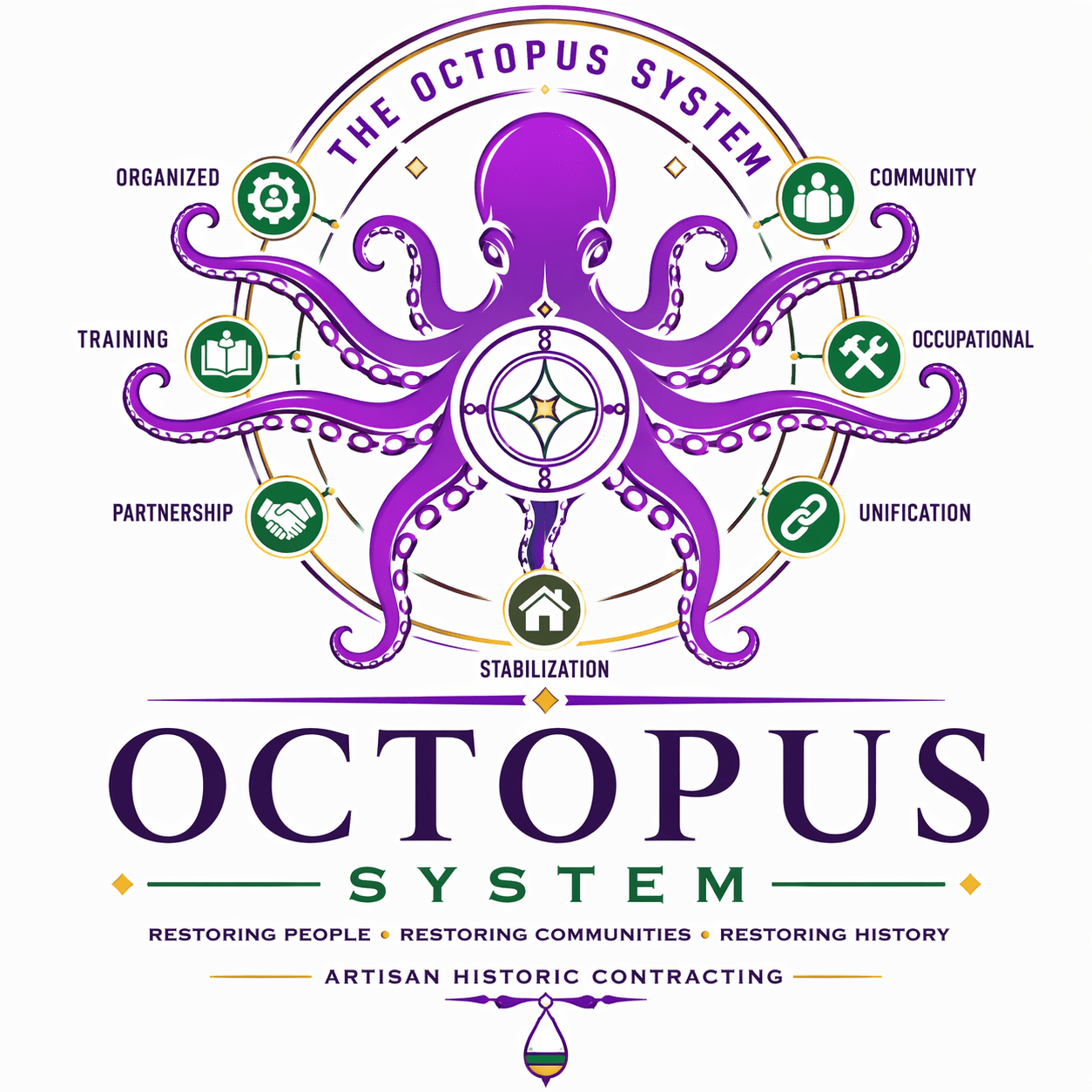
The Foundation of AHC, IGAM, and The Octopus System
Our Mission
At Artisan Historic Contracting (AHC), we believe restoration is about more than preserving buildings. It is about preserving knowledge, craftsmanship, opportunity, and the dignity that comes from meaningful work.
Our mission is to restore historic structures, preserve traditional trades, and pass on the knowledge, values, and skills entrusted to us by the master craftspeople, contractors, and mentors who came before us. We exist to ensure that historic craftsmanship survives, communities thrive, and future generations have access to the opportunities that skilled trades can provide.
The Origin of AHC
The foundation of Artisan Historic Contracting began long before the company itself. It was built through years of learning from skilled tradesmen, contractors, carpenters, and master craftspeople who invested their time and knowledge into teaching a young apprentice not only how to build and restore structures, but also how to conduct business with integrity.
These men taught lessons that extended far beyond tools and materials. They taught discipline, accountability, craftsmanship, problem-solving, customer service, project management, and the realities of operating a successful contracting business.
Their knowledge represented generations of accumulated experience. Much of what they taught was never written in books. It was passed directly from one craftsman to another through mentorship, observation, and hard work.
AHC was created to preserve that legacy.
The Creation of IGAM
As AHC grew, it became clear that restoring historic buildings alone would not be enough. The knowledge required to perform quality restoration work was disappearing. Skilled tradespeople were retiring. Apprenticeship opportunities were becoming increasingly rare. Traditional methods and craftsmanship practices were being lost.
To address this challenge, the International Guild of Artisans & Masters (IGAM) was established.
IGAM’s purpose is to document, preserve, teach, and transfer specialized trade knowledge to future generations. It serves as the educational and professional development component of the larger vision.
IGAM exists so that the skills passed down by master craftspeople do not disappear when those craftspeople are gone.
The Event That Changed Everything
On February 24, 2024, I suffered a stroke.
Like many people who survive a major health event, I was forced to stop and evaluate my life, my work, and my legacy.
During recovery, an uncomfortable realization emerged:
I had spent a lifetime learning skills that had been entrusted to me by remarkable craftsmen, yet I had not fully passed those skills on to the next generation.
The men who taught me were aging.
Some had already passed away.
Their knowledge lived largely through those they had trained.
I began to recognize that if something happened to me, much of the knowledge, methodology, practical business experience, and craftsmanship that had been passed down to me could be lost as well.
At the same time, I reflected on my own experiences with homelessness, financial hardship, and personal struggle. I remembered how difficult it had been to find housing, employment, mentorship, and opportunity when I needed them most.
That realization became the turning point.
The stroke did not create the vision.
The stroke clarified the urgency of the vision.
Why The Octopus System Was Created
The Octopus System (TOS) was created because I recognized two major problems occurring simultaneously.
Problem One:
Traditional trade knowledge was disappearing.
Master craftsmen were retiring and passing away faster than the next generation was being trained.
Problem Two:
Millions of people were struggling with homelessness, unemployment, underemployment, lack of mentorship, and limited access to meaningful career opportunities.
The solution was to connect these two challenges.
The Octopus System was designed to preserve historic trades while creating pathways for people to rebuild their lives through practical education, mentorship, apprenticeship, and employment.
Rather than treating housing, workforce development, education, support services, and employment as separate systems, TOS integrates them into one coordinated framework.
The Philosophy Behind TOS
The Octopus System is built on a simple belief:
The best way to restore a community is to restore the people who live within it.
Every historic building represents knowledge.
Every skilled trade represents opportunity.
Every apprentice represents future potential.
Every restored structure becomes a classroom.
Every project becomes a pathway.
The goal is not merely to place someone into housing.
The goal is not merely to teach a trade.
The goal is not merely to complete a project.
The goal is to create long-term self-sufficiency through meaningful work, mentorship, and opportunity.
The Three-Part Foundation
Artisan Historic Contracting (AHC)
The economic engine.
Provides real projects, real work environments, real clients, and real employment opportunities.
International Guild of Artisans & Masters (IGAM)
The educational engine.
Preserves knowledge, develops curriculum, documents craftsmanship, and supports mentorship.
The Octopus System (TOS)
The integration engine.
Connects housing stability, workforce development, apprenticeship, employment, community restoration, preservation, and economic opportunity into one coordinated system.
Our Legacy Commitment
The Octopus System is my commitment to the men who taught me.
It is my commitment to preserving the centuries of knowledge they entrusted to me.
It is my commitment to the communities we serve.
It is my commitment to the people who need a second chance, a mentor, a skill, a job, or simply an opportunity to succeed.
Most importantly, it is a commitment to ensure that neither historic craftsmanship nor human potential is ever discarded simply because someone failed to see its value.
Just as a carpenter never leaves a bent nail in place,
The Octopus System exists because we believe no community, no trade, and no person is beyond restoration.